







The humble pen, a seemingly simple tool, is in reality a conduit for creativity, communication, and precision. From signing critical documents to sketching intricate designs, the choice and skillful use of a pen can significantly impact the quality of the output and the pleasure of the process. Mastering this tool goes beyond merely holding it; it involves understanding the mechanics, the ink, the paper, and the personal grip that shapes your unique writing style. This article explores the various facets of the art of mastering pens, offering detailed answers to key questions about selection, technique, maintenance, and history. We delve into the distinctions between major pen types, provide actionable tips for improving handwriting, and cover essential care routines to ensure your writing instruments remain lifelong companions in your intellectual and artistic pursuits.
Overview
-
Pen Selection is Key: The choice of pen—fountain, rollerball, ballpoint, or marker—fundamentally affects the writing experience, legibility, and maintenance requirements.
-
Grip Matters for Comfort and Control: A proper, relaxed grip is crucial for reducing hand fatigue and improving the consistency of one’s handwriting.
-
Ink and Paper Synergy: The interaction between the pen’s ink and the paper’s texture and weight dramatically influences feathering, bleed-through, and drying time.
-
Fountain Pen Maintenance is Essential: Regular cleaning (flushing) is necessary for fountain pens to prevent clogs and ensure smooth ink flow, particularly when changing ink colors.
-
The 5W1H Framework: A structured approach addresses the What, Why, Who, Where, When, and How of the art of mastering pens, providing a holistic reference.
-
Handwriting Improvement Techniques: Simple, consistent practice focusing on stroke formation, spacing, and posture can lead to significant improvements in penmanship.
-
Historical Context: Understanding the evolution of writing instruments, from the reed pen to the modern fountain pen, provides appreciation for current technology.
What is the Art of Mastering Pens?
What does the practice of the art of mastering pens involve?
The practice of the art of mastering pens involves several interconnected elements:
-
Tool Selection:
-
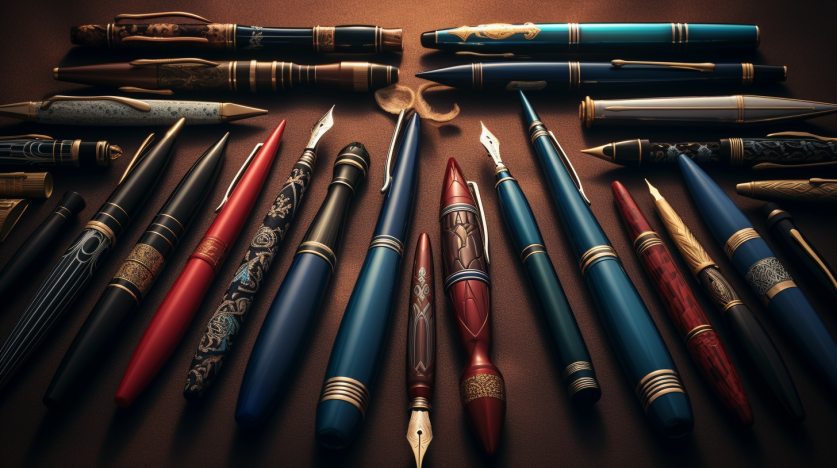
Understanding Pen Types: Knowing the characteristics, pros, and cons of major pen categories: Fountain Pens (smooth, expressive, customizable nibs); Rollerball Pens (liquid or gel ink, vibrant lines, quick flow); Ballpoint Pens (oil-based ink, archival, low maintenance); and Markers/Fineliners (felt or porous tips, consistent line width). For year and they bring these out in different materials and styles for our corporate or personal gifts
-
Matching Pen to Task: Selecting the appropriate pen for specific uses, such as a ballpoint for carbon copies, a fountain pen for personal journaling, or a fineliner for technical drawing.
-
-
Technique and Ergonomics:
-
Grip Optimization: Learning a relaxed, four-finger grip (or tripod grip) that reduces strain and allows for fluid movement.
-
Pressure Management: Developing a light touch, especially crucial for fountain pens and fineliners, to prevent damage to the nib/tip and paper.
-
Writing Posture: Maintaining an upright posture with both feet flat on the floor to support the arm and shoulder movements necessary for sustained writing.
-
-
Maintenance and Care:
-
Fountain Pen Flushing: Routinely cleaning the pen body, feed, and nib to prevent ink buildup and clogging.
-
Proper Storage: Storing pens, especially fountain and rollerball pens, either horizontally or nib-up to prevent leaking or drying out.
-
Refill Management: Knowing the correct refill types and methods for replacement for non-fountain pens.
-
Why Study the Art of Mastering Pens?
Why should someone dedicate time to learning the art of mastering pens?
There are several compelling reasons to delve into the art of mastering pens:
-
Improved Legibility and Aesthetics:
-
Better pen control directly leads to clearer, more consistent handwriting, making notes and correspondence easier to read.
-
Learning techniques like controlled line variation (with a flex nib or brush pen) adds artistic flair and personalization to one’s writing.
-
-
Reduced Hand Fatigue:
-
A correct grip and posture, combined with selecting a pen of suitable weight and girth, prevent cramps and pain during long writing sessions.
-
Fountain pens, in particular, require little to no pressure, making them ideal for writers who suffer from hand strain.
-
-
Enhanced Focus and Mindfulness:
-
The deliberate, tactile nature of using a quality pen, especially a fountain pen that requires inking, fosters a more focused and intentional approach to writing, serving as a mindful counterpoint to digital input.
-
-
Professional and Personal Impression:
-
Handwritten notes, signatures, or letters executed with a fine instrument and good penmanship convey professionalism, respect, and attention to detail.
-
Collecting and using fine pens can become a satisfying hobby, linking the user to a long tradition of craft and quality.
-
Who Benefits from the Art of Mastering Pens?
Who finds the most practical benefit from studying the art of mastering pens?
While anyone who writes can benefit, certain groups gain significant advantages from mastering the art of mastering pens:
-
Students and Academics:
-
Taking legible and fast notes during lectures and reading is critical for comprehension and recall.
-
Using a comfortable, smooth-writing pen reduces the physical barrier to high-volume note-taking.
-
-
Professionals and Executives:
-
People who sign numerous documents, write personalized correspondence, or journal for strategic planning require reliable, high-quality writing instruments.
-
The act of using an executive-level pen can become part of one’s personal brand.
-
-
Artists, Architects, and Designers:
-
Pen mastery is fundamental for inking, technical drawing, cross-hatching, and calligraphy.
-
Understanding different nib sizes (from Extra Fine to Broad) and ink properties is necessary for achieving specific artistic effects.
-
-
Journalers and Letter Writers:
-
Those who write extensively for personal reflection or communication appreciate the aesthetic pleasure and tactile feedback of a well-chosen pen.
-
The ability to use permanent, archival-quality inks is important for preserving written memories.
-
How to Apply the Principles of the Art of Mastering Pens
How can a person actively apply and practice the core principles of the art of mastering pens?
Applying the principles of the art of mastering pens requires intentional practice and methodology:
-
Assess and Adjust Your Grip:
-
Hold the pen loosely, gripping it about an inch above the writing tip.
-
The pen should rest near the base of the index finger. Your thumb, index, and middle fingers form a tripod.
-
Practice writing with only the arm and shoulder, minimizing finger movement, to see if your writing changes—this is the foundation for a relaxed grip.
-
-
Practice Controlled Strokes:
-
Dedicate time to drills: drawing straight lines, circles, and oval shapes consistently.
-
Focus on consistency in stroke pressure and speed. For fountain pens, this means maintaining a consistent angle (the nib should be oriented correctly toward the paper, generally with the slit facing the ceiling).
-
-
Use Quality Paper:
-
Write on smooth paper, ideally $90\text{g/m}^2$ or heavier, to prevent feathering and bleed-through, especially with wetter inks (rollerball and fountain pen inks).
-
Paper with a slight texture can offer pleasant feedback to a ballpoint pen.
-
-
Adopt a Consistent Maintenance Schedule:
-
For fountain pens, flush the pen every four to six weeks, or immediately before changing ink types or colors. Use distilled water for flushing to prevent mineral deposits.
-
Regularly wipe the pen body and cap with a soft cloth to remove residual ink or oils.
-
-
Study Penmanship Examples:
-
Practice copywork by replicating established script styles (like Copperplate, Spencerian, or even a simple, standardized print) to improve letter formation and spacing.
-
Focus on uniform x-height (the height of lowercase letters without ascenders or descenders) and consistent slant.
-
When and Where Did the Art of Mastering Pens Emerge?
When and where did the art of mastering pens, as a cultural and technical practice, begin to take shape?
The mastery of writing instruments has evolved alongside the development of the tools themselves:
-
When – Early Origins (3rd Century BCE and earlier):
-
The earliest forms of “pen mastery” involved the use of reed pens (used in ancient Egypt and the Middle East) and quill pens (starting in the 7th century CE).
-
Mastery at this stage centered on the craft of cutting and shaping the tip (nib) of the reed or feather to control ink flow and line width.
-
-
When – The Steel Nib Era (19th Century):
-
The mass production of durable, interchangeable steel dip pen nibs in the 1800s standardized writing.
-
Mastery shifted to fine motor control for expressive and ornamental scripts (like Copperplate), which relied heavily on pressure variation to flex the steel nib.
-
-
When – The Modern Fountain Pen (Late 19th Century onward):
-
The invention of a reliable feed system by Lewis Waterman (1884) led to the first truly portable writing instrument, the modern fountain pen.
-
Mastery became less about constant dipping and more about maintenance, nib selection, and understanding the interplay between the internal ink reservoir, the feed, and the nib.
-
-
Where – Cultural Centers:
-
China: The continuous tradition of mastering the ink brush for calligraphy deeply influenced the appreciation of line quality and ink control.
-
Europe (especially Germany and Italy): These regions became centers for high-quality pen manufacturing (e.g., Parker, Montblanc, Aurora), driving technical innovation and establishing a culture of appreciating finely crafted writing tools.
-
What are the Practical Distinctions in the Art of Mastering Pens?
What are the key practical distinctions between mastering different types of pens within the art of mastering pens?
Mastery is pen-specific, requiring different skills for each primary type:
-
Fountain Pen Mastery:
-
Skill Focus: Light pressure application (the ink is gravity-fed), nib angle consistency, and routine flushing (cleaning).
-
Key Distinctions: The user controls line variation through nib choice (e.g., fine, medium, stub), not pressure. Requires specialized ink and paper to prevent feathering.
-
-
Rollerball Pen Mastery (Gel and Liquid Ink):
-
Skill Focus: Moderately light pressure, consistent speed for even ink lay-down, and proper capping to prevent the liquid ink from drying out.
-
Key Distinctions: Provides the smoothness of a fountain pen but with the portability of a ballpoint. It uses water-based ink, which can bleed on poor paper.
-
-
Ballpoint Pen Mastery (Oil-based Ink):
-
Skill Focus: Applying the necessary pressure to roll the ball in the socket and dispense the viscous oil-based ink, maintaining a consistent grip for uniform line opacity.
-
Key Distinctions: Requires the most pressure of the major pen types. It is the most reliable on waxy or low-quality paper and is virtually maintenance-free.
-
-
Fineliner/Marker Mastery:
-
Skill Focus: Extremely light touch to protect the porous felt or plastic tip from crushing, consistent speed for maximum saturation, and maintaining a vertical orientation for uniform tip wear.
-
Key Distinctions: Primarily used for drawing, drafting, and emphasizing, offering extremely consistent line widths. Tips are delicate and easily damaged by heavy pressure.
-


